
Armed conflict · Political stability · Regional security
Tigray: Ethiopia’s old war returns with new allies
The coalition bringing Tigrayan, Amhara and Oromo armed groups together has widened the pressure on Abiy Ahmed’s government. Shared opposition to Addis Ababa does not resolve the territorial and political disputes that once placed some of its members on opposite sides of the battlefield.
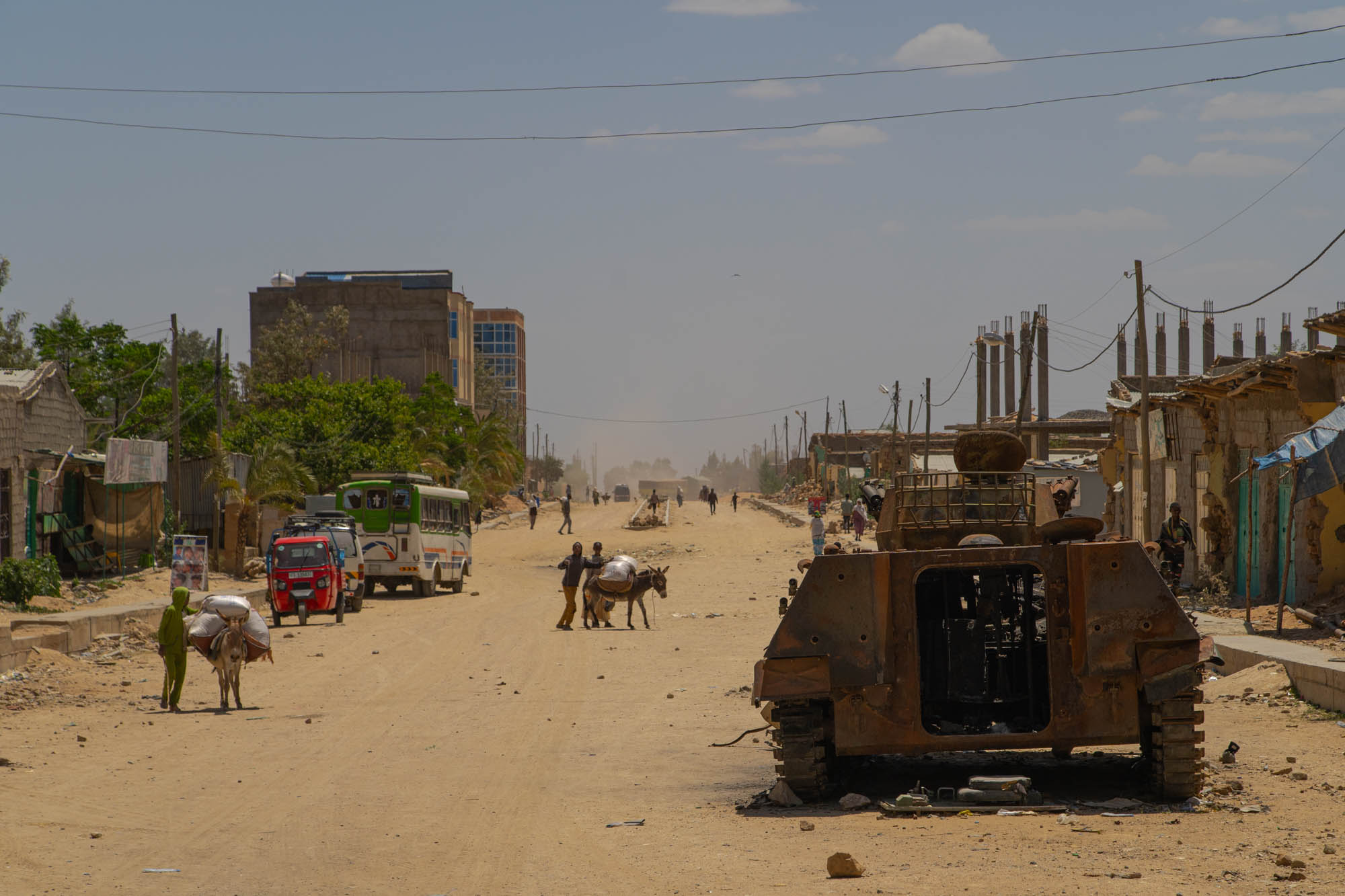
Tigrayan forces took control of the airports at Mekelle, Axum and Shire on 23 September, removing federal personnel from three of the most important installations in northern Ethiopia. Ground offensives opened almost simultaneously towards Amhara and Afar, where Tigrayan fighters operated alongside groups that had fought against them during the previous war.
Government forces have since counterattacked. By 28 September, federal troops and allied Tigrayan fighters had retaken Alamata, a strategic town on the southern approach to Tigray. Tigrayan forces, meanwhile, advanced into Afar and captured Erebti. Control remains fluid, and many battlefield claims cannot be independently verified.
The direction of travel is nevertheless clear. The security and political arrangement created after the November 2022 Pretoria agreement has effectively broken down. Fighting is no longer confined to sporadic clashes or competing military deployments. The federal government and the Tigray People’s Liberation Front (TPLF) are again engaged in sustained combat across several fronts.
The front lines resemble those of the previous war. The alliances do not.
Pretoria stopped the armies, not the argument
The war that began in November 2020 followed two years of political confrontation between Prime Minister Abiy Ahmed and the TPLF, which had dominated Ethiopia’s ruling coalition before Abiy came to power in 2018. The TPLF withdrew to Tigray as Addis Ababa dismantled the political system through which it had governed Ethiopia for almost three decades.
Full-scale conflict began after Tigrayan forces attacked the federal army’s Northern Command. Federal troops entered Tigray with support from Eritrea and Amhara regional forces. The coalition captured Mekelle within weeks but failed to destroy the TPLF. Tigrayan forces recovered much of the region in 2021 and later advanced into Amhara and Afar before federal forces, supported by armed drones and Eritrean troops, forced them back.
The Pretoria agreement ended the fighting at a moment when Tigray faced mounting military and humanitarian pressure. The TPLF accepted the restoration of federal authority and agreed to disarm. Addis Ababa undertook to restore public services, facilitate humanitarian access and establish an interim regional administration.
The agreement saved lives, reopened Tigray and allowed the two parties to step away from a war neither could end at an acceptable cost. It did not settle several of the questions that had sustained the conflict.
Western Tigray remained under Amhara control. Large numbers of displaced Tigrayans could not return, while Amhara leaders rejected any process that might transfer the territory back to Tigray. Eritrea, whose forces had played a decisive role in the war, did not sign the agreement. Neither did representatives of the Amhara forces that controlled the disputed territory. Tigrayan disarmament proceeded slowly amid continued fears of attack from both.
The agreement depended on several steps happening in the right order. Tigray was expected to disarm as federal authority and services returned; displaced people were expected to go home after contested territories received a constitutional settlement; Eritrean forces were expected to leave without having taken part in the negotiations. Little progress in one area made concessions elsewhere harder.
Political divisions within Tigray had already weakened the post-war arrangement. Getachew Reda was replaced as head of the interim administration in April 2025 by Tadesse Worede. In May 2026, the TPLF restored Tigray’s pre-war legislative council and elected Debretsion Gebremichael as regional president, creating a rival authority rather than replacing the federally recognised interim administration.
Relations deteriorated further as the TPLF accused Addis Ababa of withholding regional funds and restricting fuel supplies, while federal drone strikes increasingly targeted Tigrayan military positions. The TPLF expanded mobilisation and conscription, and African Union mediation failed to restore sustained direct talks.
By the time the TPLF announced a seven-group Alliance for Survival on 20 September, the structures created at Pretoria had already ceased to function. The coordinated offensive that followed three days later confirmed their collapse.
Old enemies now need one another
The new alliance includes the TPLF, the Oromo Liberation Army and the Amhara Fano National Movement, alongside four smaller organizations. Its declared objective is to remove Abiy’s government and establish a transitional administration.
That common objective has brought together forces with profoundly different accounts of Ethiopia’s recent history. Amhara fighters helped federal and Eritrean forces drive the TPLF out of Western and Southern Tigray during the previous war. Tigrayan leaders continue to demand the return of those territories. Fano formations regard at least part of them as historically Amhara land.
The Oromo Liberation Army has its own conflict with the federal government and its own vision of greater Oromo self-determination. Fano factions have mobilised around Amhara nationalism and opposition to the weakening of Amhara regional power. Neither movement has accepted a common political programme for governing Ethiopia after Abiy.
The alliance may therefore prove more effective at coordinating opposition than reconciling its members. Armed groups can exchange intelligence, divide federal attention and time offensives without agreeing on territorial administration, federalism or the distribution of power. Those differences would become much harder to manage if the groups began capturing and governing disputed territory.
For the federal government, even limited coordination creates a serious military problem. The Ethiopian National Defence Force is already fighting insurgencies in Amhara and Oromia. Renewed war in Tigray forces it to defend several distant fronts while protecting major roads, airports and regional capitals. An armed alliance does not have to march on Addis Ababa to erode the government’s authority or raise the cost of maintaining it.
The federal government still holds important advantages. It retains air power, armed drones, heavy weapons and the ability to draw personnel from across the country. The opposition groups vary greatly in size and capability. They have not demonstrated that they possess a unified command, secure supply arrangements or the political cohesion required for a prolonged national campaign.
The capture of Alamata also shows that the first Tigrayan advances did not produce an irreversible shift in the balance of power. Government forces can recover territory, particularly when they combine air strikes with support from local allies. A rapid opposition advance towards the capital, comparable to the Tigrayan push south in 2021, remains unlikely.
A longer war of attrition is more plausible. The alliance can compel Addis Ababa to disperse forces, while each member continues fighting for largely local objectives. Federal counteroffensives may contain the groups without resolving the conflicts that sustain them. Ethiopia would then face several connected wars rather than one unified rebellion.
Tigray is poorly placed to absorb another such campaign. Before the present fighting, FEWS NET assessed that Crisis levels of food insecurity would persist across eastern Tigray and that some households could face Emergency conditions. Poor rains had damaged the harvest, while humanitarian assistance remained constrained.
Medical services are already coming under pressure. The number of war-wounded patients received at hospitals in Korem and Alamata rose from approximately 180 over a 48-hour period to more than 420 between 22 and 25 September, according to Médecins Sans Frontières. More than 300 wounded patients reached Suhul Hospital in Shire by 25 September. Fighting forced MSF to suspend its work at Alamata hospital and halt several outreach programmes.
Closing roads, airports or communications for any extended period would affect civilians long before either side achieved a military advantage.
The war is drawing in Ethiopia’s regional rivalries
The sharpest reversal since the previous war concerns Eritrea. President Isaias Afwerki’s forces fought alongside the Ethiopian army between 2020 and 2022. Eritrea regarded the TPLF as an enduring threat after decades of border conflict and hostility. Relations between Addis Ababa and Asmara have since deteriorated, while Eritrea and the TPLF have found a shared interest in weakening Abiy.
Ethiopia’s army chief, Field Marshal Birhanu Jula, has accused Eritrea of arranging support for the TPLF and alleged that Sudan and Egypt are also involved. He has not provided public evidence. Eritrea and Sudan deny supporting the offensive, while Egypt says that it respects Ethiopia’s sovereignty and territorial integrity.
The accusations still reveal how Addis Ababa interprets the conflict. It no longer sees renewed fighting in Tigray as an isolated domestic rebellion. Ethiopian officials increasingly describe it as part of a regional alignment involving governments that have separate disputes with Abiy.
Ethiopia and Eritrea remain divided over Addis Ababa’s demand for reliable—and at times sovereign—access to the Red Sea. Egypt’s dispute with Ethiopia over the Grand Ethiopian Renaissance Dam remains unresolved. Relations with Sudan have become entangled with the Sudanese civil war, competing allegations of support for armed factions and the longstanding dispute over the al-Fashaga borderlands.
These interests do not amount to a stable anti-Ethiopian coalition. Eritrea and the TPLF retain deep mutual distrust. Egypt’s priority is the Nile rather than Tigrayan autonomy. Sudan’s armed forces are preoccupied with their own war. None necessarily wants the collapse of the Ethiopian state.
They may still provide money, weapons, sanctuary or diplomatic support if doing so increases their leverage over Addis Ababa. Such assistance could prolong Ethiopia’s conflicts without producing the formal intervention seen during the previous Tigray war.
Direct Eritrean involvement remains the most dangerous possibility. A federal advance towards Mekelle would bring Ethiopian forces closer to the Eritrean border and could prompt Asmara to reinforce its positions or assist Tigrayan forces more openly. An Eritrean intervention would in turn strengthen calls inside Ethiopia for a broader national mobilisation.
Fighting in Afar presents a different risk. Tigrayan forces have so far operated in the northern part of the region, away from the principal road and railway connecting Addis Ababa to Djibouti. A deeper advance, or sustained coordination with Afar armed groups, would bring the conflict closer to the corridor through which most of Ethiopia’s imports and fuel arrive. Disruption there would turn a northern security crisis into a national economic one.
Sudan’s civil war offers another route for escalation. International Crisis Group reports that Sudan has hosted Tigrayan fighters in territory controlled by the Sudanese armed forces. Addis Ababa, meanwhile, faces allegations that it has allowed support to reach the Rapid Support Forces. Both conflicts would become more difficult to contain if the Sudan–Ethiopia border developed into a supply route or rear base for their opposing belligerents.
Neither side has an easy route to victory
The federal government will probably continue using drones and ground forces to reverse opposition gains outside Tigray. TPLF forces are likely to defend the region’s southern and eastern approaches while relying on their partners to keep federal troops engaged elsewhere.
Neither side appears capable of achieving its wider political objective quickly. The alliance has not shown that it can threaten Addis Ababa or agree on what should replace Abiy’s government. Federal forces may recover towns without dismantling the armed movements behind the offensive. An attempt to remove the TPLF from Mekelle would require a much larger campaign and risk another humanitarian disaster.
The immediate question is whether the fighting remains concentrated around Tigray’s borders or develops into simultaneous, sustained offensives across Amhara, Oromia and Afar. A federal state of emergency, wider mobilisation by the alliance, further restrictions on Tigray and visible Eritrean military deployments would point towards a longer national conflict.
Control of the airports will also matter. Their seizure removed one of the clearest remaining symbols of federal authority inside Tigray. Retaking them would require Addis Ababa either to negotiate or to push substantially deeper into the region.
The African Union, the United Nations and IGAD continue to present Pretoria as the framework for de-escalation. The agreement remains useful as a commitment to a ceasefire, humanitarian access and political dialogue. Restoring it word for word would not address the changes that have occurred since 2022.
Any durable settlement now has to confront the questions Pretoria deferred: the administration of contested territories, the return of displaced people, the security arrangements surrounding disarmament, Tigray’s place in federal institutions and the role of neighbouring states. It will also have to account for armed groups that were never party to the original agreement.
The September offensive has not yet produced a coherent national challenge to Abiy’s government. It has created something potentially more difficult to contain: a set of separate Ethiopian conflicts whose participants have begun to see value in fighting at the same time. Whether that cooperation survives its first reversals will help determine whether this remains another Tigray war—or becomes the point at which Ethiopia’s separate conflicts begin to merge.
Speak with our analysts
What does this mean for your organization?
If renewed conflict in Ethiopia could affect your people, operations or regional plans, our analysts can help you assess the implications and identify the developments that matter.
Contact our analysts