
Elections · Political stability · Governance
Serbia votes after two years in the streets
The student movement born after the Novi Sad railway station collapse now presents the strongest electoral challenge to Serbia’s governing party in more than a decade. Sunday’s vote may determine who controls parliament. Whether it produces a transfer of power will depend on institutions shaped by fourteen years of SNS rule.
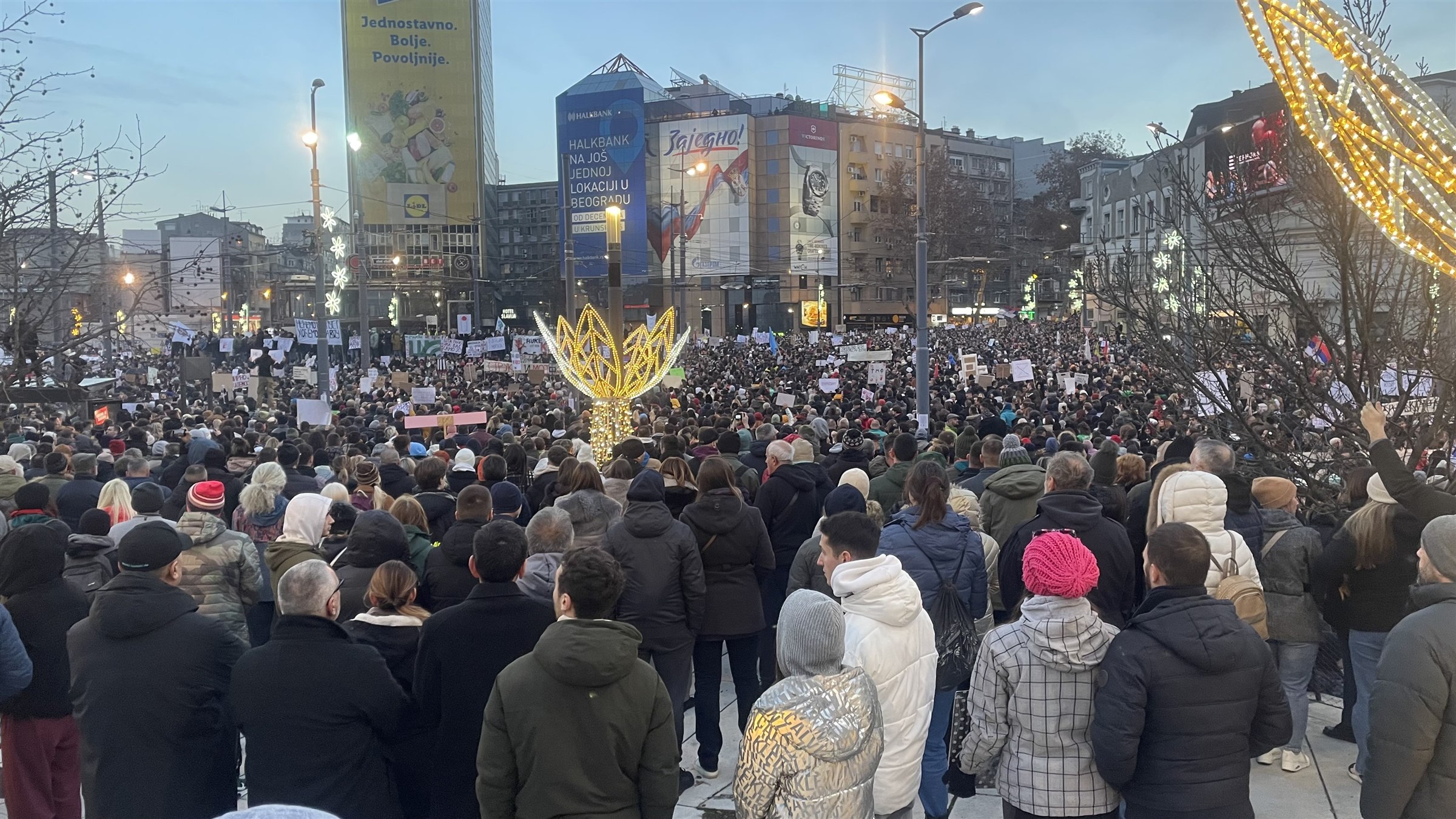
At 11:52 on 1 November 2024, a concrete canopy collapsed outside Novi Sad railway station. Sixteen people eventually died.
The station had recently reopened after renovations carried out as part of the Belgrade–Budapest railway project. The work involved a Chinese consortium and proceeded under an intergovernmental agreement that placed parts of the project outside Serbia’s ordinary public procurement system.
Public anger initially centred on the railway project: who had approved the work, why key contracts remained confidential and whether political connections had taken precedence over professional oversight. As the investigation stalled, the questions widened. Students occupied university buildings, organised marches across the country and demanded the publication of project documents and criminal accountability for the collapse.
Nearly two years later, that movement is contesting power.
Serbia will elect a new parliament on 25 October. The governing Serbian Progressive Party (SNS), led into the campaign by former president Aleksandar Vučić, faces a Students’ List composed largely of academics, doctors, teachers and other candidates drawn from outside established party politics.
The election has taken on the character of a referendum on fourteen years of SNS government. Polling offers no reliable indication of the margin. One recent survey placed the Students’ List slightly ahead; another gave Vučić’s coalition a double-digit lead. The differences are too large to reflect ordinary sampling error and reveal how little independent information exists about a highly polarised electorate.
The ballot may establish which side commands more votes. It may prove less conclusive about who can govern, whether defeat would produce an orderly transfer of power and how much of Serbia’s political system would change with the government.
The failures exposed by the Novi Sad disaster remain unaddressed
The canopy case has progressed further through the courts than it had when the protests began, but it has not produced a trial or a settled account of responsibility.
An appeals court confirmed an indictment against 13 former officials, railway executives and construction professionals in June. The start of the trial was subsequently delayed while the Supreme Court considered challenges brought by several defendants. Separate investigations have examined financial flows, possible corruption and the conduct of officials responsible for supervision.
This leaves a gap between legal procedure and public expectation. The criminal case concerns the decisions and failures that may have caused the structure to collapse. The protests came to encompass a broader system in which major public works could proceed through confidential contracts, special legislation and limited external scrutiny.
The Students’ List has built its programme around that distinction. Its proposals include a special prosecutorial police unit, an examination of unlawfully acquired assets, publication and review of public contracts, changes to the appointment of senior officials and greater independence for regulators and public broadcasters.
The programme provides considerably more detail on institutional reform than on taxation, energy, foreign policy or the management of Serbia’s largest investments. Its candidates argue that access to government records must come first: they cannot responsibly decide which projects to revise until they know what the state has signed and what cancellation would cost.
That caution is understandable. It also postpones some of the choices a new government would face almost immediately. Serbia is preparing for Expo 2027, negotiating over energy security and the ownership of its oil industry, and supporting infrastructure projects whose schedules extend well beyond the next parliamentary term.
The Students’ List has united voters around accountability without yet resolving the economic and political disagreements that would emerge after victory. Its candidates range from environmental campaigners and public-sector professionals to economists with different views of monetary policy, state spending and foreign investment.
Opposition to the SNS has kept those differences secondary during the campaign. Government would bring them to the surface.
A close result leaves the opposition dependent on institutions it does not trust
The election campaign has provided little reassurance that the count will command confidence across the political divide.
Election monitor CRTA recorded 116 incidents involving physical violence or verbal threats by the final week of the campaign. It also identified more than 650 public appearances containing elements of misuse of office or state resources. On national television, representatives of the authorities received almost three-quarters of the airtime devoted to political actors. Coverage of the Students’ List was overwhelmingly negative.
The voter register presents a separate source of distrust. An audit commission did not receive all the data required to assess allegations of duplicate entries, fictitious residence and other irregularities before polling day. CRTA has also raised concerns about approximately 30,000 voters whose names appear outside the expected alphabetical order in polling-station extracts.
None of these issues determines the result in advance. Their political importance will depend on the margin.
A clear victory would make individual irregularities less likely to alter the distribution of power. A close contest would place greater weight on polling-station records, complaints procedures and decisions taken by the Republic Electoral Commission and the courts. The Students’ List would then have to seek redress from institutions that its supporters accuse of serving the governing party.
Smaller parties may further complicate the outcome. Several are polling close to the 3% threshold, while recognised minority lists qualify under different rules. Whether these parties enter parliament could change the seat allocation even if the gap between the two largest lists remains small.
Coalition arithmetic would then become as important as first place. Vučić’s coalition may be able to remain in government with the support of the Socialist Party and minority representatives even if it falls short of a majority on its own. The Students’ List would probably need cooperation from parties it has spent much of the campaign keeping at a distance.
The most sensitive period will begin after polling stations close. A disputed count, delays in publishing station-level results or credible reports of intimidation could bring demonstrators back onto the streets. Belgrade and Novi Sad would be the main centres of protest, but the movement’s reach into smaller cities means disruption may not remain confined to the capital.
The OSCE election observation mission is expected to issue its preliminary assessment on 26 October. Its findings will shape the international response, but they will not settle the domestic argument if the parliamentary majority depends on a small number of seats.
The SNS could lose office and retain influence across the state
Vučić resigned the presidency on 27 September, seven months before the end of his final term, and entered the parliamentary campaign as the SNS candidate for prime minister. The move allows him to pursue executive power through a different office while presenting the election as a choice between his leadership and an untested student movement.
An SNS victory would preserve the political centre of gravity. Vučić would return to a position he previously held between 2014 and 2017, this time with a premiership shaped by the authority he accumulated during nearly a decade as president. The formal balance between Serbia’s institutions would change less than the office from which he exercised influence.
An opposition victory would create a more difficult transition.
The SNS has governed since 2012. During that period, it has established influence across ministries, municipalities, public enterprises, regulators and state-supported media. Senior appointments may change quickly, but the administrative networks built around the party will not disappear on election night.
A student-led government would need experienced officials to keep the state operating while it examined appointments, procurement decisions and alleged abuses of office. Moving too slowly could leave established networks in place. Moving indiscriminately could remove professional staff alongside political appointees and obstruct the institutions the new government needs to use.
The police and prosecution services would present the most immediate test. The Students’ List has promised stronger prosecutorial independence and investigations into corruption. Those investigations would depend on officials who have worked under the outgoing government and may themselves face questions about previous decisions.
The same problem would arise in public companies and local government. Managers appointed under the SNS oversee transport, energy, utilities and large capital projects. Replacing them without disrupting services would require a more selective process than campaign language about removing political influence sometimes suggests.
Vučić would also remain an important political actor outside government. He has a national organisation, loyal media support and a direct relationship with much of the SNS electorate. If the Students’ List formed a fragile coalition, the SNS could use parliament, municipalities and public demonstrations to challenge its authority while waiting for internal disagreements to appear.
Losing the election would therefore not necessarily end Vučić’s influence. It could instead move the contest from the ballot box into the institutions through which Serbia is governed.
Serbia’s largest public projects would face renewed scrutiny under a student-led government
A change of government would first affect projects associated with opaque contracting or special legal treatment.
Expo 2027 would receive immediate attention. Serbia has tied the exhibition to a larger programme of roads, railways, housing, visitor facilities and a national stadium. Some contracts have been awarded outside ordinary procurement procedures, while a special law exempts parts of the programme from Serbia’s standard procurement rules.
Students’ List candidates have stopped short of promising to cancel the exhibition. They have instead called for publication of the contracts and an independent examination of costs, safety and the state’s obligations. That review could preserve some projects, renegotiate others and refer suspected wrongdoing for investigation.
For contractors and investors, the distinction matters. Political change would not automatically invalidate contracts. Serbia would still face termination clauses, financing commitments, arbitration risks and the practical cost of abandoning work already under construction.
The same considerations apply to transport and energy projects agreed with foreign governments. A new administration may object to the process through which a contract was awarded while concluding that cancellation would impose a greater cost than completion. Reviews would nevertheless delay approvals, payments and new procurement while officials establish which commitments remain defensible.
Rio Tinto’s Jadar lithium project would face a different calculation. The project remains politically divisive because of environmental concerns, distrust of regulatory oversight and its association with Vučić’s development policy. At the same time, the European Union has identified Jadar as strategically important to its critical-minerals supply.
A student-led government could require a new environmental and contractual review without rejecting the project outright. The decision would expose differences within the coalition between environmental campaigners, local opponents and those who see lithium processing as an opportunity to attract higher-value industry.
These reviews would take place within an economy that retains substantial buffers. The IMF expects growth of approximately 2.8% in 2026, while public debt remains moderate, foreign-exchange reserves are adequate and the banking system is well capitalised. Serbia is not entering the election with the conditions of an immediate financial crisis.
Political uncertainty could still weaken investment and delay decisions. Foreign direct investment fell sharply in 2025, and the IMF has warned that domestic political tensions could further affect confidence and reform. The greater near-term risk is not a sudden breakdown in the economy but an extended pause while a new government examines contracts and an outgoing political network resists scrutiny.
Vučić’s departure would not settle Serbia’s foreign alignment
Vučić has maintained close economic relations with the European Union while cultivating political and commercial ties with China, Russia and the Gulf states. That balance has attracted investment and allowed Serbia to avoid choices that successive EU governments have urged it to make.
The EU remains Serbia’s principal trade and investment partner. China has become important in mining, steel, automotive manufacturing and infrastructure. Russia retains influence through energy ties, public sympathy and its support for Serbia’s position on Kosovo.
A government led by the Students’ List would probably speak more directly about EU standards, judicial independence and public procurement. Those issues are central to the movement’s domestic programme and to Serbia’s stalled accession process. A credible reform effort could improve relations with Brussels and unlock political momentum that has been absent for several years.
Foreign policy would change more slowly.
The Students’ List has not presented a detailed position on sanctions against Russia, recognition of Kosovo or the future of Chinese investment. Its supporters include voters with sharply different views on all three. An immediate attempt to resolve them could fracture the coalition before its institutional reforms had begun.
Commercial interests would also constrain policy. Chinese companies operate major industrial assets and participate in infrastructure projects that Serbia cannot replace quickly. Russian gas remains important even as Belgrade seeks greater supply diversity. European investment depends partly on the same political stability and administrative capacity that a contested transition could weaken.
Kosovo would remain the most difficult issue. No Serbian government could make rapid concessions without facing substantial domestic opposition. A new administration might adopt a less confrontational tone and cooperate more closely with EU mediation, but it would inherit the same constitutional claims, security concerns and political risks as its predecessor.
An SNS government would continue the existing balance, although a narrower majority could make foreign policy more tactical. Vučić would still seek European funds and market access while resisting pressure that threatened his domestic position or relations with Moscow and Beijing.
Sunday’s ballot can remove a government. Whether it changes how Serbia is governed will depend on what follows the count: who controls the institutions, which contracts are opened to scrutiny and whether the investigation that began in Novi Sad finally reaches a conclusion.
Speak with our analysts
What does this mean for your organization?
If Serbia’s election could affect your investments, contracts, workforce or regional plans, our analysts can help you assess the result, the prospects for an orderly transition and the decisions most likely to affect your operations.
Contact our analysts